
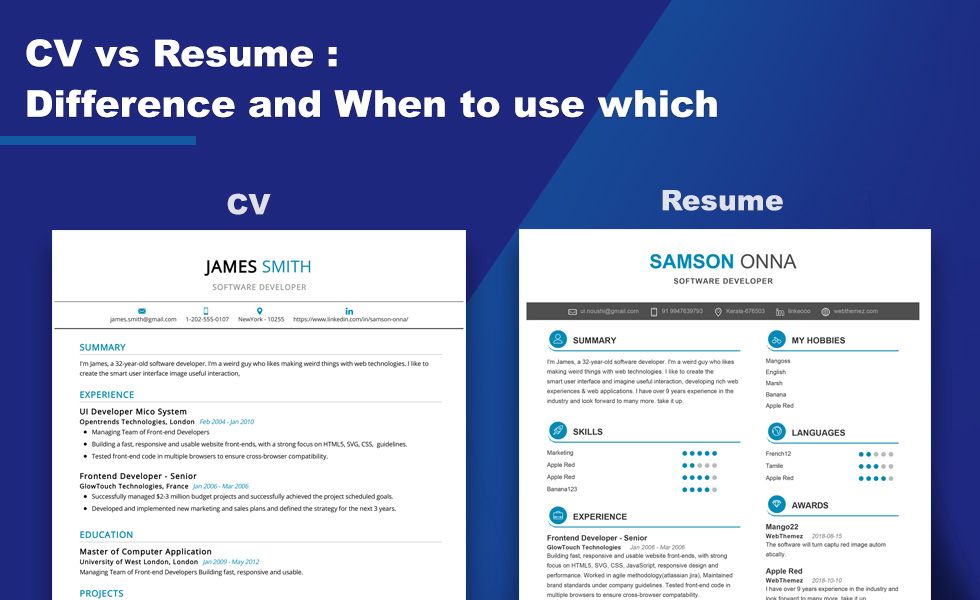
When it comes to a job application, one of the initial questions that job seekers ask themselves is whether to present a resume or a CV. The purpose of the two documents is the same: to report on your professional/educational background to your potential employer. Nevertheless, there is a big difference between the two, which can greatly influence the perception of your application. It is important to know the differences, uses, and situations of each to give yourself the best opportunity to succeed.
What Is a CV? A curriculum vitae (also known as a CV) is an elaborate and exhaustive document, as it describes the academic and professional background of a person. In comparison with a resume, a CV may occupy several pages and cover a lot of educational, research, publications, work experience, awards, and other achievements information. CVs are particularly common in the academic sector, within scientific studies, medicine, and where international application is necessary, and where a precise history of qualifications is needed.
What Is a Resume?
Conversely, a resume iahe brief and focused outline of the skills of the candidate, work experience, and achievements. A resume is usually one to two pages and is specific to the job one is applying to. It highlights relevancy, brevity, and clarity, which can assist the hiring managers in making fast decisions on whether you are suitable for the role. Whereas a CV is concerned with recording all your career life, a resume is only concerned with the most important things of any job.
Significant Disagreements between a CV and a Resume.
A CV and a resume do not only differ in their length. A CV is elaborated since it is a list thatincludess every detail of the academic and professional history. It typically has some research, publications, professional associations, conferences visited, and an awards section. A resume, in its turn, is selective, as it draws attention to the achievements and experiences that would be most applicable to a specific job.
Customization is another significant difference. CVs are typically kept in a fixed format, whereby they are revised periodically as opposed to being revised based on the job application. The resumes should, however, be tailored to fit the application, keeping in mind the qualifications that best match the job requirements. To assist the professionals in this process, Professional CV writing in Dubai services may offer the necessary skills to make sure that both the CVs and the resumes are well organized and adapted to the job market in the region.
Geographic Considerations
The place has a significant influence on the choice of the document to use. Most industries in North America and, most prominently, the United States and Canada, use resumes. Employersinf these areas demand a brief, concise overview of experience and skills. Instead, sending a CV can be considered an unnecessarily long and overwhelming process.
CVs are more popular in Europe, the Middle East, and Asia, among other parts. Most employers in such locationsrequiree detailed descriptions of education and experience. Being aware of the expectations in the region would make your application meet the normal hiring practices in that area.
Industry Expectations
CVs and resumes are preferred differently in diverse industries. In academic, scientific, and medical spheresa CV is almost always needed since one should disclose the description of the research, publications, and professional achievements. A CV in these areas depicts professionalism and authority.
The resumes are preferred by corporate industries such as business, marketing, technology, and finance. Employers in these industries favor conciseness and target achievable outcomes, pertinent competency and specific accomplishments. With a well-organized resume, communication becomes fast and easy as to why you are a good contender for the job.
The perception of Employers on CVs and Resumes.
Employers have been known to think differently about your application depending on whether you have used a resume or a CV. A CV can be comprehensive, professional, anda long-term investment in a discipline. However, practical skills or immediate effect in a role may lead to the most pertinent information being lost when using a long CV.
On the other hand, resumes are clear and efficacious. A resume can help you to be fast-tracked by employers by highlighting the main accomplishments and talents, andshowingw how well you fit the available job opening. This can be a big difference when it comes to being shortlisted in a fast-paced process of recruitment.
Personalization and Irrelevance.
The flexibility of a resume is one of the best strengths. Applicants are able to customize a resume to each application and outline areas of their experience that fit the job description. Such a degree of personalization is important to show that you have done your research on what the employer requires and have made the effort to show that you are a good fit.
CVs are more rigid and elaborate. They provide an in-depth overview of a career as opposed to what is most applicable to a particular job. This may work against someone in competitive markets where recruiters look through hundreds of applications within a short period of time.
Length and Detail
The other significant factor in determining the use of a CV or a resume is length. CVs are usually several pages and contain a lot of information in terms of academic projects, certifications, research work, and work memberships. This makes them best suited for jobs that require extensive documentation.
Resumes are not long and are usually one or two pages. They put emphasis on high-impact information, i.e, on quantifiable accomplishments, relevant experience, and critical skills. A resume being short makes sure that the employer is able to understand the qualifications of the applicant within a limited period of time, which is most important in industries that afast-pacedced.
Making the Right Choice
The decision to use a CV or resume will be based on a number of factors, with the factors being region, industry, position, and expectations of the employer. A CV can be preferred to a resume in the case of an academic, research, or international job. When applying to a majority of corporate positions, a specific and concise resume is more successful. The trick is to know the situation and put your qualifications in the format that the employer is looking.
Conclusion
Conclusively, CVs and resumes play their roles in job applications. A resume is a specific summary of a job applicant and their crcredentials depending onjob positionnt, depending on whereas a CV is a detailed accounttheir his career and education history. Awareness of the differences, regional and industry norms, and the ability to tailor your application to them are important measures that will greatly help in increasing your chances of success. Proper use of form can help the candidate to communicate their qualification, create a good impact on the employer, and increase their chances of winning interviews.