
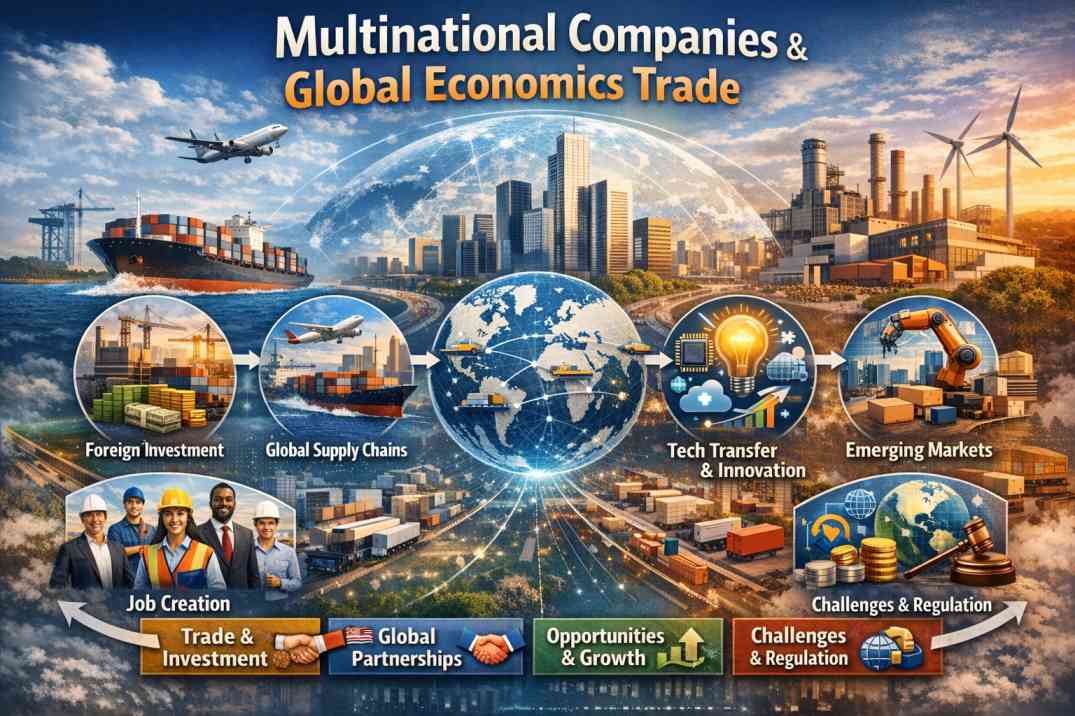
Introduction to Global Economics Trade and Multinational Companies
The modern world economy is deeply interconnected, and one of the most influential drivers behind this integration is the rise of multinational corporations. These companies operate across multiple countries, managing production, distribution, and services on a global scale. In the context of global economics trade, multinational companies serve as key engines that move capital, goods, services, and knowledge across borders. Their operations help shape the patterns of international trade, investment, and economic growth.
Today, more than 60% of international trade involves multinational companies, either through direct exports, imports, or internal transactions between their global subsidiaries. This highlights how central these firms are to global economics trade. From technology giants and automotive manufacturers to logistics providers and financial institutions, multinational corporations create networks that connect markets worldwide. For organizations like HG Markets, understanding how these corporations operate in global markets provides valuable insight into trade trends, business partnerships, and economic opportunities.
Understanding Multinational Companies in the Global Economy
Multinational companies, often referred to as MNCs, are organizations that manage business operations in more than one country. They typically maintain a headquarters in their home nation while establishing branches, subsidiaries, or production facilities in foreign markets. These companies expand internationally to reach new customers, reduce production costs, access natural resources, and gain competitive advantages.
In global economics trade, multinational corporations act as bridges between different national economies. They help integrate markets by enabling the exchange of products, technology, and capital. For example, a company may design a product in Europe, manufacture components in Asia, and sell the finished product in North America. This global distribution of production activities increases efficiency and allows countries to specialize in industries where they have economic strengths.
For businesses such as HG Markets, understanding the structure and strategy of multinational companies can open the door to collaboration, supplier relationships, and participation in international supply chains.
Multinational Companies as Drivers of Global Trade
Multinational corporations significantly influence how international trade operates. They often manage complex supply chains that span several continents, ensuring that raw materials, components, and finished products move efficiently between countries. This structure allows them to take advantage of cost differences, technological capabilities, and market demand in various regions.
In the framework of global economics trade, multinational companies help expand international markets by increasing the volume and diversity of goods traded worldwide. Their presence encourages countries to improve infrastructure, reduce trade barriers, and adopt policies that support cross-border business. For example, multinational retailers and manufacturers often require advanced logistics networks, which can lead to investments in ports, transportation systems, and digital trade platforms.
These developments not only support the companies themselves but also create opportunities for smaller firms that wish to connect with international markets through partnerships or supplier roles.
Foreign Direct Investment and Economic Expansion
One of the most powerful tools multinational companies use to expand internationally is foreign direct investment (FDI). Instead of simply exporting products, these corporations invest directly in foreign economies by building factories, offices, research centers, or distribution facilities. Such investments play a critical role in strengthening global economics trade by increasing production capacity and encouraging economic cooperation between countries.
According to the United Nations Conference on Trade and Development (UNCTAD), global FDI flows have reached over $1 trillion annually in recent years, with multinational corporations responsible for most of these investments. When a multinational company invests in a developing economy, it often creates jobs, improves infrastructure, and stimulates local industries.
For companies like HG Markets, this environment can create opportunities to participate in expanding markets, collaborate with global investors, and benefit from the broader economic development triggered by multinational investment.
Global Supply Chains and Production Networks
Another crucial contribution of multinational companies is the creation of global supply chains. Instead of producing everything in one location, corporations divide the production process across multiple countries. Each stage—such as raw material extraction, manufacturing, assembly, and distribution—may take place in different regions depending on costs and expertise.
This system plays a vital role in global economics trade because it increases efficiency and productivity. For instance, electronics companies often manufacture components in specialized facilities across Asia, assemble devices in another country, and distribute them worldwide. Such networks enable businesses to produce high-quality goods at competitive prices.
For businesses like HG Markets, understanding global supply chains is essential for identifying where value is created in international trade. Companies that position themselves strategically within these networks can gain access to global markets and long-term business partnerships.
Technology Transfer and Innovation Across Borders
Multinational corporations are also powerful agents of technological advancement. When they expand into new countries, they frequently bring advanced technologies, management practices, and research capabilities with them. This process, often called technology transfer, allows local economies to benefit from global innovation.
In the context of global economics trade, technology transfer can significantly boost productivity and competitiveness in host countries. Local companies often learn new manufacturing techniques, digital tools, and quality standards by working with multinational partners. Over time, this knowledge spreads throughout industries, improving the overall economic environment.
Companies like HG Markets can benefit from this innovation-driven ecosystem by adopting new technologies, collaborating with global partners, and implementing modern business strategies that enhance efficiency and market reach.
Employment Opportunities and Workforce Development
Multinational corporations also influence labor markets across the world. When these companies establish operations in foreign countries, they often create thousands of jobs directly through their facilities and indirectly through suppliers, logistics providers, and service companies.
In many cases, multinational companies offer training programs and skill development initiatives that help workers adapt to modern technologies and international business standards. This contributes to human capital development, which is essential for sustaining global economics trade. Skilled workers are better equipped to participate in complex international supply chains and knowledge-based industries.
For companies such as HG Markets, the development of a skilled workforce within global trade networks means access to better talent, improved productivity, and stronger collaboration opportunities across markets.
Challenges and Criticism of Multinational Influence
Despite their many contributions, multinational companies are not without controversy. Critics argue that these corporations sometimes prioritize profits over environmental sustainability, labor standards, or fair taxation. Concerns about tax avoidance, market dominance, and unequal economic influence often arise when discussing the role of multinational firms in global economics trade.
Governments and international organizations are increasingly working to address these issues by implementing stricter regulations and promoting corporate responsibility. Policies related to environmental protection, fair labor practices, and global tax transparency aim to ensure that multinational companies contribute positively to economic development.
For businesses like HG Markets, staying aware of these regulatory changes is crucial for maintaining compliance and building a reputation as a responsible participant in global markets.
Strategic Opportunities for Companies Like HG Markets
The growing influence of multinational corporations creates a wide range of opportunities for companies seeking to expand internationally. Organizations such as HG Markets can leverage global trade networks by forming strategic partnerships, becoming suppliers to multinational firms, or exploring emerging markets that benefit from foreign investment.
Participating in global economics trade requires businesses to understand international regulations, cultural differences, and supply chain dynamics. Companies that invest in global market knowledge, digital infrastructure, and strong logistics capabilities often find themselves better positioned to compete on an international scale.
By aligning their strategies with global trade trends, businesses can transform multinational networks into powerful growth channels that expand their reach beyond domestic markets.
Conclusion: The Lasting Impact of Multinational Companies
Multinational corporations have become central pillars of global economics trade, shaping how goods, services, and capital move across borders. Through foreign investment, global supply chains, technological innovation, and employment creation, these companies influence economic development in both developed and emerging markets.
Their ability to connect economies and coordinate production across continents has transformed international commerce into a highly integrated system. For organizations like HG Markets, understanding the role of multinational corporations is essential for navigating modern trade environments and identifying new opportunities for growth.
As global markets continue to evolve, multinational companies will remain powerful catalysts for economic integration, technological progress, and international collaboration.
FAQs
1. What is global economics trade?
Global economics trade refers to the exchange of goods, services, capital, and technology between countries. It involves international markets, trade agreements, and multinational companies that facilitate cross-border economic activity.
2. Why are multinational companies important in global trade?
Multinational companies drive global economics trade by investing in foreign markets, managing international supply chains, and expanding trade networks that connect economies worldwide.
3. How do multinational corporations benefit developing countries?
They often bring foreign direct investment, create jobs, introduce advanced technologies, and improve infrastructure, which can accelerate economic development.
4. What challenges do multinational companies create?
Some challenges include tax avoidance concerns, market dominance, labor issues, and environmental impact. Governments often regulate these corporations to ensure fair and responsible practices.
5. How can companies like HG Markets benefit from global trade?
Companies can benefit by partnering with multinational firms, participating in global supply chains, expanding into new markets, and leveraging international investment opportunities within global economics trade.