
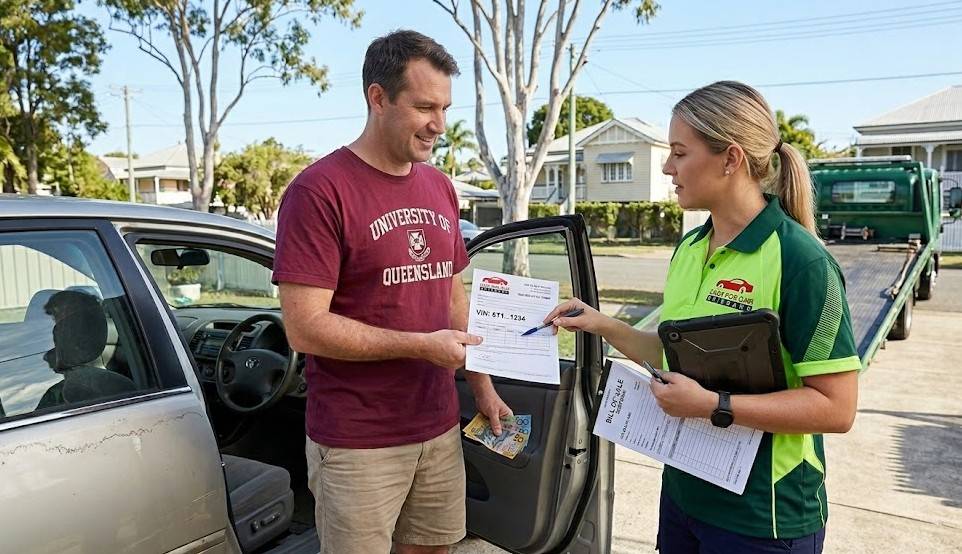
A valid receipt for a scrap car sale in Brisbane is a written document that confirms the legal transfer of ownership and includes specific details like the Vehicle Identification Number (VIN), the sale price, and the buyer’s motor dealer licence number. Under Queensland’s Second-hand Dealers and Pawnbrokers Act 2003, businesses buying vehicles for scrap must maintain a transactions register. Obtaining a formal receipt protects you from future liabilities such as speeding fines, toll charges, or illegal dumping penalties associated with the vehicle after it leaves your property.
The Importance of a Formal Paper Trail
In Queensland, a verbal agreement or a handshake is insufficient for the permanent disposal of a motor vehicle. Because cars are high-value assets tracked by the Department of Transport and Main Roads (TMR), the “title trail” must be explicitly closed to end your responsibility as the registered operator.
A legitimate receipt serves 3 critical functions:
-
Release of Liability: It proves the exact date and time you ceased being responsible for the car’s actions.
-
Tax and Insurance Proof: It provides the necessary documentation to cancel your insurance policy and claim a pro-rata registration refund.
-
Legal Compliance: It ensures the transaction follows anti-theft and scrap metal industry regulations.
Essential Details Required on a Scrap Car Receipt
A valid receipt must contain specific data points to be considered a legal “Bill of Sale” in Brisbane. If a document lacks these details, it may be rejected by TMR or insurance providers during a dispute.
| Required Detail | Function | Example/Specificity |
| Full Entity Name | Identifies the legal buyer. | Cash For Car Brisbane |
| Licence Number | Proves the buyer is a licensed dealer. | QLD Motor Dealer Licence #12345 |
| Date & Exact Time | Establishes the cutoff for fines/tolls. | 14/05/2026 at 2:15 PM |
| Vehicle Identifier | Uniquely identifies the car. | 17-character VIN or Chassis Number |
| Sale Price | Records the financial transaction. | $550.00 (Paid via EFT/Cheque) |
| Signatures | Confirms mutual agreement. | Both Seller and Buyer/Driver |
Step-by-Step Guide to Securing Your Receipt
Follow these 4 steps to ensure your paperwork is water-tight before the tow truck departs.
1. Verify the Buyer’s Licence
Before the transaction begins, ask to see the buyer’s Queensland Motor Dealer or Second-hand Dealer licence. Licensed operators are required by law to display or produce this information. Dealing with an unlicensed “backyard” operator often results in a lack of paperwork, which leaves you legally exposed.
2. Cross-Check the VIN and Odometer
Ensure the receipt accurately reflects the vehicle being sold. Locate the 17-character VIN on the dashboard or door pillar and compare it to the number written on the document. Including the final odometer reading provides additional proof of the vehicle’s condition at the time of the handover.
3. Request a Digital and Physical Copy
While a handwritten receipt on a carbon-copy book is standard, many modern services provide a digital PDF receipt via email. Having both ensures that you have a backup if the physical paper is lost. A digital record is also easier to upload to the TMR website when lodging a Notice of Disposal.
4. Confirm the Payment Method
Under QLD scrap metal laws, many high-value transactions are moving away from cash to traceable methods like Electronic Funds Transfer (EFT). Ensure your receipt clearly states the method of payment and provides a reference number for the transaction.
Why “Cash” Receipts Require Extra Scrutiny
In the scrap industry, “Cash for Cars” is a common marketing term, but the actual receipt must still be professional. If you receive physical currency, the receipt must explicitly state “Paid in Full” to prevent the buyer from later claiming the transaction was incomplete.
Pros and Cons of Different Receipt Types
| Receipt Type | Pros | Cons |
| Official Dealer Invoice | Highest legal standing; easy for TMR. | Requires the dealer to have a system on-site. |
| Handwritten Bill of Sale | Quick and easy for “as-is” sales. | Prone to legibility issues and missing details. |
| Email/SMS Confirmation | Hard to lose; timestamped by a server. | May not be accepted by some government agencies. |
Common Use Cases for a Valid Receipt
There are 5 specific situations where you will be asked to produce your scrap car receipt:
-
Cancelling QLD Registration: TMR requires proof of disposal to process your F3517 form.
-
Insurance Refunds: Your insurer will not stop your premiums without a “Proof of Sale” date.
-
Toll Disputes: If the tow truck passes through a Linkt portal and the car is still in your name, the receipt waives the fee.
-
Centrelink Reporting: If you receive benefits, you may need to report the income from the sale of an asset.
-
Police Inquiries: If the car is found abandoned or involved in an incident post-sale, the receipt is your “get out of jail free” card.
Examples of Scrappable Assets
When selling to a Brisbane wrecker, you might be disposing of various vehicles. Ensure the receipt lists the specific type:
-
Passenger Vehicles: Sedans, hatchbacks, and station wagons.
-
Commercial Fleet: Vans, utes (Utility Vehicles), and light trucks.
-
Recreational: 4WDs, caravans, and boat trailers.
Formatting for Featured Snippet
What should be on a scrap car receipt in Brisbane?
A scrap car receipt in Brisbane must include the buyer’s name and motor dealer licence number, the seller’s details, the date and time of sale, the vehicle’s VIN, the sale price, and signatures from both parties.
Situational Relevance: Selling Unregistered Cars
Many Brisbane residents sell cars that have been unregistered for years. In these cases, you do not have current “rego papers” to give to the buyer. The receipt becomes the only link in the chain of ownership. Without it, you have no way to prove to the Queensland Government that you no longer own the “wreck” sitting on your property.
Target Audience for This Guide
-
Private Sellers: Individuals clearing out a garage or driveway in suburbs like Chermside, Mt Gravatt, or Indooroopilly.
-
Executors of Estates: People managing the assets of a deceased relative who need a clear audit trail.
-
Small Business Owners: Handing over old delivery vans or work utes that are no longer tax-deductible.
Conclusion
Securing a valid receipt is the most critical part of selling a vehicle for scrap in Brisbane. It transforms a simple trade into a legally recognized disposal, protecting your finances and your reputation. By insisting on a document that includes the VIN, the buyer’s licence details, and a clear timestamp, you ensure a “clean break” from your old car.
Do you have an old car taking up space? Contact us today for a professional valuation and a guaranteed legal receipt for your sale.