
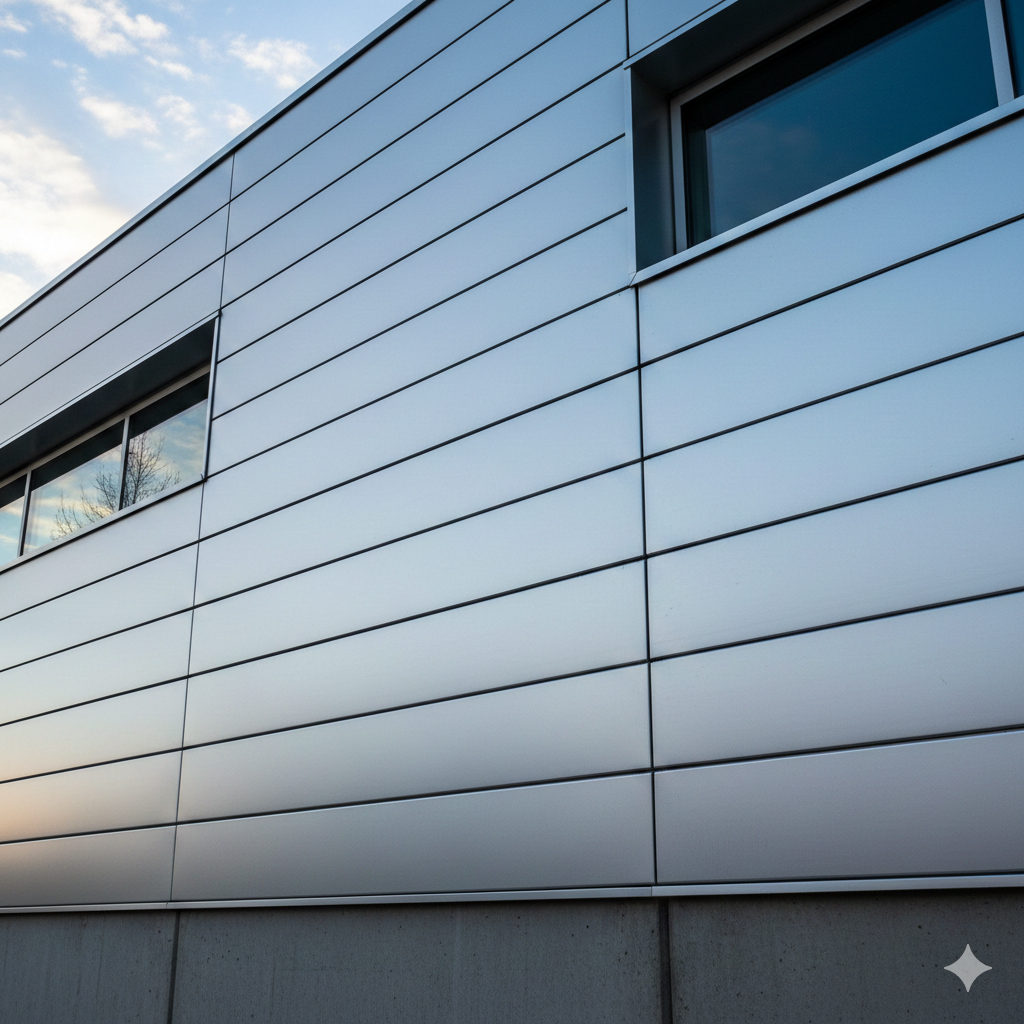
Aluminum composite material gives you a lightweight, flat, and durable panel made from two thin aluminum sheets bonded to a core, so you can choose a solution that balances strength, appearance, and cost. It performs well for cladding, signage, and architectural accents because it combines stiffness and weather resistance with easy fabrication.
This article will help you understand how ACM is constructed, what core types (like polyethylene or fire-resistant mineral cores) mean for safety and performance, and where each option fits practical needs. You’ll also see common applications and performance trade-offs so you can pick the right material for your project with confidence.
Understanding Aluminum Composite Material
Aluminum composite material blends thin aluminum skins with a central non-metal core to deliver strength, light weight, and a smooth finish. You’ll learn how it’s built, which core types exist, and the specific properties that make it useful in façades, signage, and interiors.
Composition and Structure
Aluminum composite material (ACM) consists of two thin aluminum sheets bonded to a core material. The aluminum skins typically range from 0.2–0.5 mm thickness each, and the core thickness usually falls between 2–6 mm depending on stiffness and application.
You should note common core materials: polyethylene (PE) for standard panels and mineral or fire-resistant (FR) cores for higher fire performance. The bonding uses high-strength adhesives and roll-bonding or continuous lamination to create a stable sandwich panel.
Key structural advantages come from this layered construction: the skins provide tensile strength and weather resistance, while the core controls weight, rigidity, and thermal behavior. Edges are often folded or sealed to protect the core from moisture and mechanical damage.
Types of Aluminum Composite Material
ACM categorizes mainly by core composition and surface finish. Core options include:
- PE core: Lightweight and cost-effective; used for signage and interior cladding.
- FR/mineral core: Contains a non-combustible mineral blend; required where building codes demand improved fire performance.
You’ll also find variations by skin alloy, coating, and finish:
- Alloys: Commonly 3000- and 5000-series aluminum for corrosion resistance and formability.
- Coatings: PVDF or polyester paints for UV resistance; anodized finishes for metallic appearance.
- Formats: Flat panels, curved panels, and perforated panels for acoustic or aesthetic needs.
Choose core and finish based on regulatory requirements, building height, exposure conditions, and desired appearance. Fabrication methods—cutting, routing, bending—depend on panel thickness and skin ductility.
Key Properties and Benefits
ACM offers a high strength-to-weight ratio: it provides rigidity similar to heavier materials while reducing dead load on structures. You’ll save on structural framing and installation time because panels are lighter and easier to handle.
Durability and weather resistance come from coated aluminum skins that resist corrosion and fading. Thermal and acoustic performance depend on core type and panel assembly; FR cores improve fire performance, while thicker cores raise acoustic insulation.
Aesthetic flexibility ranks high: you can get solid colors, metallics, woodgrain, and custom prints. Fabricators can form tight radii and complex shapes, making ACM popular for façades, signage, and interior features. Finally, lifecycle considerations include recyclability of aluminum skins and, in some cases, core materials—check local recycling streams when specifying materials.
Applications and Performance
Aluminum composite material (ACM) combines lightweight aluminum skins with a core to deliver stiffness, weather resistance, and a paint-ready surface. You’ll find it where low weight, flatness, and visual finish matter most.
Architectural Uses
You can use ACM for exterior cladding, curtain walls, and fascias because it provides uniform flatness and a consistent finish across large panels. Panels resist wind loads and thermal movement when properly engineered; you should specify panel size, support framing, and joint details to meet local wind and seismic requirements.
ACM’s painted or PVDF-coated surfaces offer long UV and color retention for façades, reducing maintenance frequency. You must consider fire-rating — choose A1/A2 or tested fire-retardant cores where codes require it. For retrofit and new builds, ACM simplifies installation with rivets, concealed fasteners, or stick systems.
Industrial Applications
You’ll use ACM in transportation (rail cars, buses), appliance housings, and machine enclosures where weight savings and surface durability improve efficiency. Its low density reduces fuel or energy use in vehicles, while the panel rigidity protects internal components.
ACM tolerates fabrication: cutting, routing, and bending allow custom shapes and small run parts. When exposed to oils, solvents, or abrasive environments, select appropriate core and surface treatments to preserve performance. For heat-critical parts, verify continuous operating temperature limits and thermal expansion compatibility with adjoining materials.
Signage and Branding
ACM serves as a standard for flat, durable sign faces and channel letters because it accepts digital printing, vinyl, and direct-mounted hardware. You can create large-format, lightweight signs that install easily and stay true without sagging.
The material’s smooth surface yields sharp graphics and consistent color reproduction. For illuminated signs, choose fire-rated cores and check heat dissipation around LEDs. Fastener selection and edge sealing prevent moisture ingress that could degrade adhesives or graphics over time.
Performance Considerations
When specifying ACM, evaluate mechanical strength, core composition, surface coating, and fire classification. Test panel flexural rigidity, peel strength of the skin-to-core bond, and impact resistance relative to expected service loads to ensure longevity.
Consider environmental exposure: UV, salt spray, and thermal cycling affect finish and corrosion potential at cut edges. Detail joints, edge seals, and compatible fasteners to mitigate galvanic corrosion. Finally, align core selection with code requirements and application risks — mineral cores for fire-prone locations, polymer cores where weight and cost dominate.
 John Ryan