
Introduction
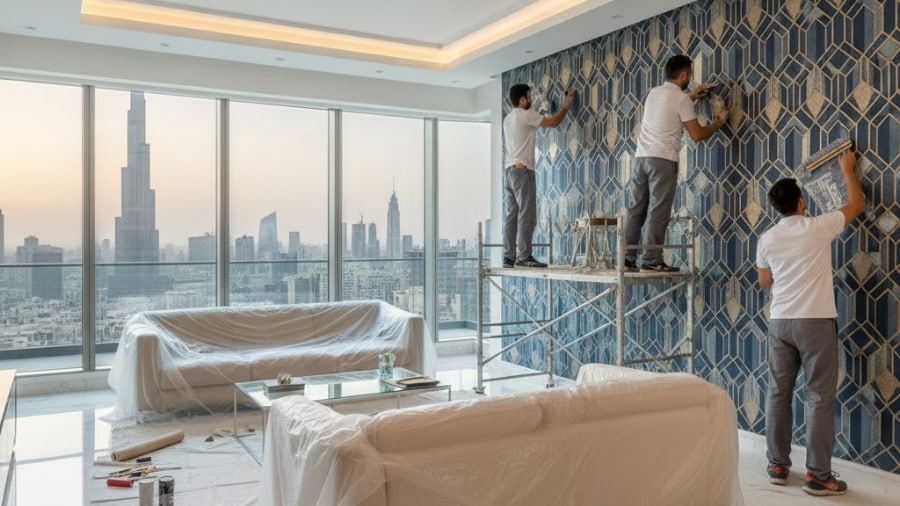
The architectural environment is associated with innovation, high-end lifestyle, and vibrancy in the city of Dubai. The built environment in the city of Dubai is ever-challenging the limits of design, whether it is awe-inspiring skyscrapers or ultra-luxury residential projects. In this regard, interior spaces have become very important canvases on which creative expression is done, and all the details add to the entire aesthetic experience. Wallpaper installation has been a prominent part of the interior finishes, in addition to being a functional finishing. This paper discusses the application of wallpaper installation in Dubai as part of the interior environments, its cultural appropriateness, design influences, material development, sustainability, and the future.
Cultural and Aesthetic Background
Dubai survives in the crossroads of the world and regional tradition. The city interiors usually reflect the duality, being a mixture of modern style and traditional practises based on the Middle East culture. The wallpaper installation in Dubai also contributes to this game, allowing designers and house owners to use the local motifs as well as adopt the international ones.
Modern wallpaper designs have re-interpreted traditional Arabic designs, using geometric tessellation and calligraphy, and provided the transition between the past and the present. Consequently, Dubai interior spaces can tell cultural stories without having to lose the contemporary sophistication. As an example, a hotel lobby with luxury design can use walls covered with Islamic geometry to establish a sense of location, whereas an abstract design of wallpaper can be used in a modern house to create a cosmopolitan touch.
Enhancing Spatial Dynamics
Wallpaper can manipulate the perception of space. Spatial dynamics (depth, scale, and rhythm) are essential in interior design to influence user experience. Wallpaper is also strategic in this. Expansive rooms can be made to be more edited and purposeful by large-scale patterns, and perceived height can be added to a low ceiling by vertical lines. On the other hand, feature walls can be given textured wallpapers so that they do not fill up a room.
Wallpaper is commonly applied to delineate spaces and express architectural elements in the luxury residential and commercial interiors of Dubai, where the quality of space is of importance. An illustrative instance is to use textured wallpaper in a reception area of an executive office that can be used to mark a workplace area versus a reception space, and a graphic mural in a high-end retail store that can direct customer traffic as well as support a brand name. These applications show how wallpaper is not just a decorative aspect, but it is also a part of the spatial architecture.
Technology and Innovation of Materials
The wallpaper business has developed outstandingly in the past ten years, with the progress made in materials and printing technology. The interior projects in Dubai, which can include both high-end villas and integrated resort complexes, have also led to a boom in the market of custom, high-performance wallpaper solutions.
The design opportunities of wallpaper have been increased by printing technologies, including digital large-format printing. The remarkable precision and color fidelity with which custom murals and photographic textures, as well as brand-specific graphics, can now be printed is truly astonishing. These are the capabilities that allow bespoke design to be used in such a manner that, in markets such as Dubai, where custom design is, in most cases, a distinguishing factor, an architect or interior designer can create very customized environments that encompass the aspirations of the client.
Functional Advantages
Although the use of wallpaper can be viewed as a surface finish mainly in terms of visual appeal, its practical input is also very strong. The modern wallpapers can enhance the acoustic environment, mask the irregularities on the surfaces, and enhance the quality of the indoor environment.
Acoustic wallpapers that are made with sound-absorbing layers are being applied in various settings like boardrooms, home theatres, and hospitality living rooms. These wallpapers will assist in the reduction of reverberation and comfort without the use of heavy acoustical panels. The textured wallpapers, when used in homes, cover small wall flaws and offer a smooth outlook without the use of a lot of plastering.
Sustainability Considerations
Sustainability has been a key issue in design in the global world, and Dubai is not an exception. Eco-friendly inks and water paint coatings have less environmental impact and promote more favorable indoor air quality. Other manufacturers are even coming up with wallpapers that can be recycled once their lifespan is over, which is contributing towards the principles of the circular economy.
Adding new sustainable wallpaper does not just comply with the regulatory or certification standards; it also appeals to clients who are environmentally friendly. With the Dubai real estate market becoming more mature, sustainability qualifications are becoming increasingly important in the buying and leasing process of real estate, making wallpaper an important element of responsible interior design.
Lighting and Interior System Integration
The interiors of Wallpaper installation in Dubai often overlap with lighting design. The slowness of wallpaper, be it matte, satin, metallic, or textured, and the play it makes with natural and artificial light create atmosphere and mood.
Walls like pearl and metallic wallpapers have the ability to remove and reflect light and thus have a dynamic effect and make the space richer. The effects have a role in building an atmosphere of glamour and exclusivity in a luxury retail store and hospitality environment. Dark or dull wallpapers, however, can be used to create a very comfortable and personal experience, which can be applied in lounges, spas, or bedrooms at home.
The Challenges and the Best Practices
Wallpaper installation has some difficulties, despite its benefits. The degree of humidity (which is high in the climate of Dubai) may influence the way the adhesion is created, especially in poorly ventilated places. To achieve longevity, one should choose the right adhesive systems and methods of substrate preparation. Complex designs or texture material demands professional fitting, particularly with complicated patterns, which necessitates a professional labor force to coordinate and drill with precision.
Some of the best practices entail properly making surface observations, applying moisture-resistant materials in the right areas, and ensuring that mechanical systems are synchronized to ensure that interior environments are stable. Hiring the services of skilled installers who are knowledgeable of the local conditions also alleviates the risk that comes with the use of the wallpaper.
Future Prospects
With the development of Dubai as a universal design center in the world, it is expected that the scope of installation of wallpaper will grow in terms of size and complexity. The next generation of interior design will be dominated by emerging trends in the form of interactive wallpapers, complete with in-built lighting or digital displays, bio-inspired materials, on-demand prints, etc.
Additionally, the contribution of smart technologies, like wallpapers with sensors that monitor the environmental conditions, might reestablish the practical purpose of wall coverings. In an urban area that encourages innovation, wallpaper can either become a lifeless design object or an active component of smart interior arrangements.
Conclusion
Installation of the wallpaper interior space in Dubai is one of the examples of the integration of art, technology, and the use of culture. It enhances space dynamics, brand and cultural narrative, provides functionality benefits and cultivates sustainability goals. As the interior design phenomenon in Dubai turns into a more refined and technologically endowed phenomenon, the wallpaper will remain a flexible and highly powerful tool, which will not only impact the surfaces, but also experiences.